Insights
“Incrementality is a scam” and other things people say when measurement lets them down
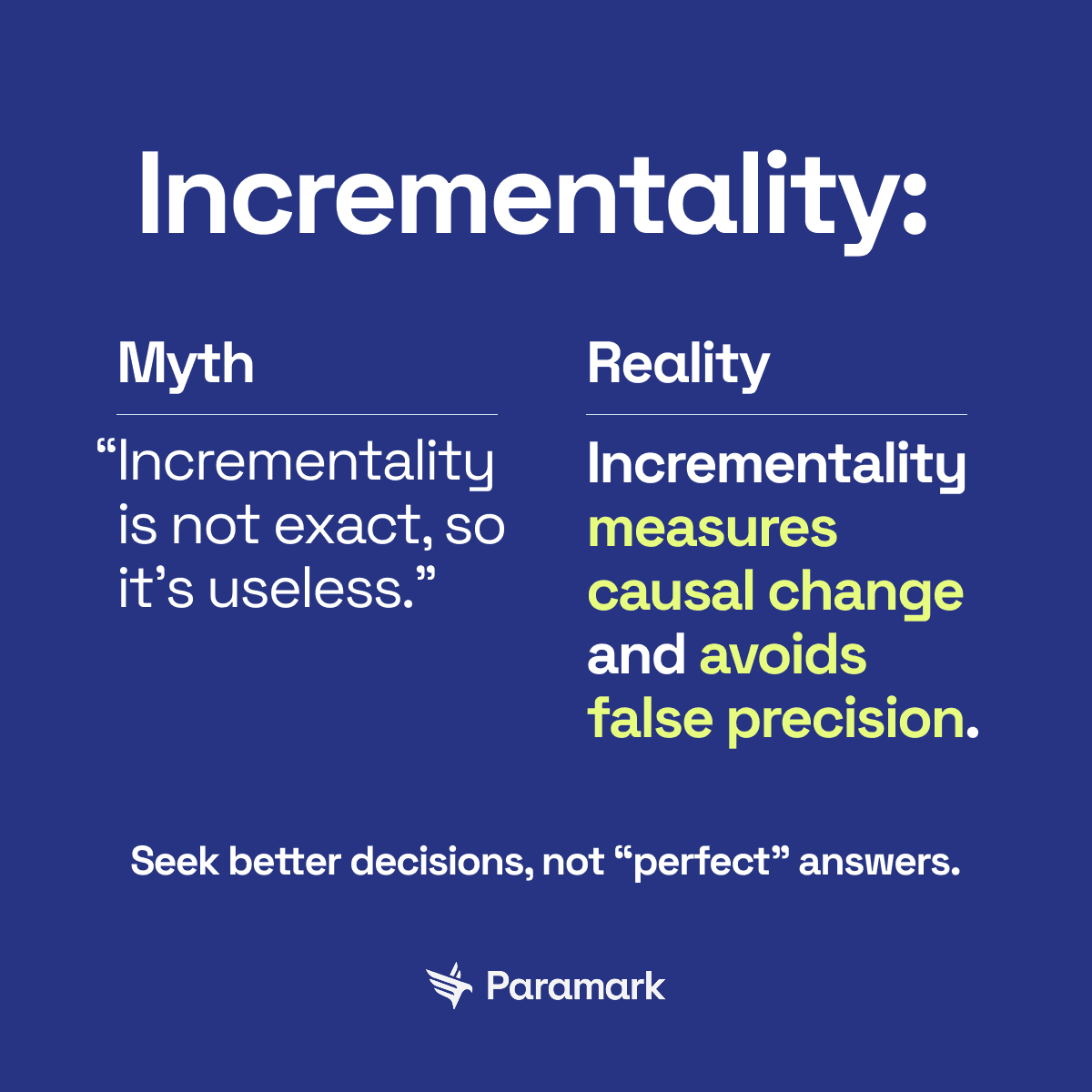
How accurate is incrementality? Because of the discomfort and skepticism around incrementality, we naturally see opposition emerge. We’ll be the first to admit that science-backed incrementality doesn’t promise you a perfect truth to the decimal point. But it does promise informed decisions.

Pete Belknap
Co-founder, CTO
The reasons for measurement skepticism
If you've been in marketing long enough, you've earned your skepticism.
You watched measurement change its character – from clean and confident to fuzzy and probabilistic.
From 2010 to 2020, platform attribution was gospel. Our dashboards looked decisive and actionable. But today’s measurement models speak in ranges and require interpretation, caveats and judgment.
That shift changed whether people trust measurement at all.
Across leading marketing orgs trying to justify spend, a consistent pattern emerged:
A channel got cut after an experiment showed “no lift,” only for pipeline to dry up three months later. Two models conflict in a QBR, and you watch leadership gravitate toward the one that feels safer, not truer.
Over time, marketers grew skeptical because they spent more time defending their spend than critically thinking about it.
So when we hear people say “Incrementality is outdated,” or “This is just murky science,” we find that they’re usually not making a technical argument.
They’re reacting to something deeper:
A collapse of trust in marketing measurement.
How did we get here? The loss of deterministic comfort
Not that long ago, marketing felt cleanly measurable.
You had:
Clicks
Conversions
ROAS
Channel-level certainty
Maybe the numbers weren’t always right, but they were legible. They gave marketers something incredibly valuable: the feeling of control.
Then our foundations shifted. Privacy changes, platform fragmentation, the use of channels that don't have clicks (e.g. CTV, direct mail, YouTube and TikTok) and more complex buyer journeys shattered the attribution illusion. We moved from clean-looking answers to messy ones.
But instead of getting more precise measurement, the modern platforms today offer:
Ranges
Models
Probabilities
It makes sense that this shift has triggered a very human reaction:
“Wait, we went from precise answers I could act on to outputs I’m not sure I can trust. Are these really more useful?”
That’s the core of incrementality skepticism.
In reality, incrementality answers a simple question:
“If we change this spend, does the business meaningfully change?”
The strawman argument: “Incrementality promises truth, but it’s imperfect”
Because of the discomfort and skepticism around incrementality, we naturally see opposition emerge.
Skeptics argue that:
Seasonality ruins incrementality tests
Consideration cycles are too long to measure
LTV can’t be fully measured
Incrementality doesn’t work at smaller scales
Revenue ≠ profit
Therefore…incrementality is just another false promise.
None of these critiques are wrong. What is wrong is the leap they make next.
Because no serious measurement practitioner believes that:
Tests work regardless of seasonality
Short experiments explain long buying journeys
LTV can be perfectly forecasted
Models deliver exact answers
The incrementality math doesn’t need to be adapted for business type (size, region, etc.)
We’ll be the first to admit that real, science-backed incrementality doesn’t promise you a perfect truth to the decimal point.
But it does promise informed decisions.
The false choice marketers face
Once the trust in measurement is lost, marketers often feel forced to either:
Obsess over perfecting models and math, or
Abandon measurement and “just watch profit”
Incrementality and Marketing Mix Modeling (MMM) can never replace your judgement. They empower your judgement with measurement.
Every marketing dollar is already a bet, whether you measure it or not. Choosing not to measure is an uncontrolled experiment, and obsessing over the perfect math is a limiting one.
Incrementality exists as a happy medium.
What incrementality does tell you
Incrementality is not here to tell you:
The true LTV of every customer
The exact ROI of every impression
Whether marketing caused all growth
We answer a simpler, practical question:
“If we change this spend, does the business meaningfully change?”
That’s it. It’s not mushy and philosophical. It's not perfectly precise.
It’s causal and directional.
Incrementality allows you to make better informed decisions about where to place your next dollar.
Think of incrementality less as a microscope and more as a guardrail. You won’t see every pebble or crack in the pavement. But you will know when you’re about to drive off a cliff.
Addressing the real concerns about incrementality
Seasonality?
Poor test design is what hurts incrementality, not timing. Leading teams compare like-for-like periods, use controls and then read results as ranges, not absolutes.
Long consideration cycles?
Incrementality captures short-term causal lift. MMM provides long-term context. One estimates; the other validates.
Revenue vs. profit?
This one is exactly why incrementality matters. We isolate what marketing caused from what would’ve happened anyway. We ground marketing’s impact in net new dollars, instead of meaningless metrics like clicks and impressions.
LTV uncertainty?
We don’t need perfect foresight to avoid budget misallocation. You need marginal proof; in other words, you need enough confidence to reallocate spend without regret.
Smaller scale businesses?
The same incrementality math that works for large advertisers can work at smaller scales, too. But you need to aim for higher lift with each test, or be comfortable with a wider range of uncertainty in your results.
If incrementality feels uncomfortable, think of it this way
Incrementality forces us to give up something that feels right in the moment: false certainty.
Instead of, “This channel works,” we have to get used to saying, “This channel works within this range, under these conditions.”
The new version can feel weak, but it’s more credible.
Try this mental model:
Attribution shows paths
MMM shows patterns
Incrementality shows cause
Together, MMM and incrementality give you confidence to:
Defend spend without making things up
Invest in brand without crossing your fingers
Reallocate budget without panic
Admit what didn’t work, and then move on
One final takeaway
As marketing got harder to measure cleanly, many experienced operators stopped trusting measurement altogether.
Many of them started mistaking uncertainty for uselessness.
But incrementality doesn’t claim certainty. It allows us to operate honestly without it.
In modern marketing, that’s progress – and the first step toward telling a genuine story about how your team delivered.
P.S. Download the one-pager of this article and share it with your team.
While you're here




Find your edge
Book a demo now and you'll get a live, expert-run walk through of how Paramark can help you with incrementality measurement and experimentation.