
The Brandformance Podcast

Gong on bold bets, real data, and earning enterprise trust

Or listen where you get your podcasts

Or listen where you get your podcasts

Episode Highlights

Transcript

Behind the expert

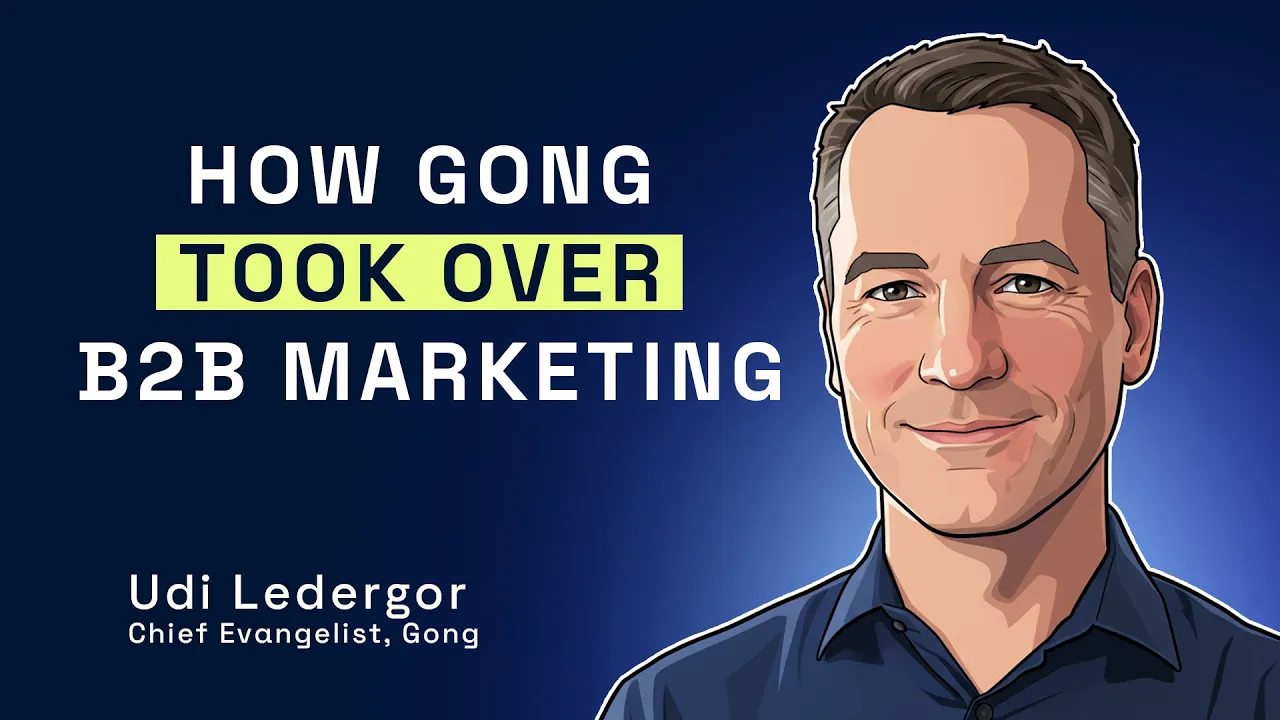
Udi Ledergor is Gong’s chief evangelist and former CMO. He helped push Gong “far past” $300M ARR, built Gong Labs, and wrote Courageous Marketing. 

During a recent episode of Branformance, Udi covered how to publish data people actually need, de-risk audacious ideas, evolve from stunts to enterprise trust, and protect your own career.

This will be incredibly useful if you're looking to inspire marketing that moves revenue, not just impressions.

The gist

  • Publish what settles debates: Use proprietary data to answer the arguments your buyers already have.

  • Test big ideas, small: Start with the smallest version that’s “big enough to be indicative.”

  • Grow up without going dull: Keep the distinct voice while proving you’re enterprise-ready and trustworthy.

  • Choose your arena wisely: Psychological safety and product-market fit determine how bold you can be.

How to turn courageous into repeatable

Ship content that ends arguments
Udi didn’t chase topics Gong thought were interesting. Instead, he listened for debates sales leaders already had and answered them with data. 

As he put it, Gong Labs asked, “What are the best salespeople do to get the next call, how long do they talk, how many questions do they ask, when do they discuss pricing,” even “What's the impact of salespeople using a dirty word here and there on a sales call.” 

The recipe: Analyze anonymized product data, segment by average vs. top vs. bottom performers, and publish clear behaviors people can adopt. Sometimes the answer is as specific as, “Turns out the answer is about four.”

Bet bold, then buy down the risk
The posture starts with upside: “I like to focus a lot more on the opportunity than on the risk.” That’s how a Super Bowl idea became practical, by stitching together regional buys where target accounts live rather than paying for a national spot. Udi’s bar for any first test: small enough not to hurt, big enough to read.

Evolve from stunts to enterprise trust
Zero to ~250M is about grabbing mindshare; the next chapter is consistency. Udi’s team kept the brand’s voice but acknowledged that selling to massive companies means proving stewardship: “Half of the Fortune 10 companies are using Gong right now.” The work shifts from being seen to being trusted by executive buyers.

Build cultures where bold work is safe
Bold ideas require psychological safety. Udi described leaders who invite “crazy” ideas and treat most choices as reversible: “Most decisions are retractable at Amazon, call it two-way door.” When misses aren’t career crimes, teams actually take the swings that produce step-function wins.

Protect your own tenure
Great marketers can’t fix missing product-market fit. Do your diligence like an investor (customers, reviews, culture, leadership expectations), so you don’t take a role where marketing is set up to fail.

What Udi shared with us

  • “At the end of last year, we hit 300 million in ARR, and we're far past that already mid-year.”

  • “If you want extraordinary growth, you've got to do something extraordinary.”

  • “I like to focus a lot more on the opportunity than on the risk.”

Why this matters for your roadmap

Your market needs evidence and confidence, instead of more ads. Publish data that answers real questions, run the smallest readable version of bold ideas, and upgrade trust signals as you climb into enterprise. Meanwhile, choose leaders and products that let you do the kind of work worth defending.

Practical next steps

  1. List five live debates your buyers are having, then design one anonymized data study to answer one clearly.

  2. Re-scope one “too big” idea into a regional or time-boxed pilot that can actually read.

  3. Audit enterprise trust signals (security, references, executive narratives) without sanding off your voice.

  4. Confirm psychological safety before you ask your team to swing big.

Pick one courageous move this quarter, one that's small, real, and measurable, and let the results open the next door.

Episode Highlights

Transcript

Behind the expert

Udi Ledergor is Gong’s chief evangelist and former CMO. He helped push Gong “far past” $300M ARR, built Gong Labs, and wrote Courageous Marketing. 

During a recent episode of Branformance, Udi covered how to publish data people actually need, de-risk audacious ideas, evolve from stunts to enterprise trust, and protect your own career.

This will be incredibly useful if you're looking to inspire marketing that moves revenue, not just impressions.

The gist

  • Publish what settles debates: Use proprietary data to answer the arguments your buyers already have.

  • Test big ideas, small: Start with the smallest version that’s “big enough to be indicative.”

  • Grow up without going dull: Keep the distinct voice while proving you’re enterprise-ready and trustworthy.

  • Choose your arena wisely: Psychological safety and product-market fit determine how bold you can be.

How to turn courageous into repeatable

Ship content that ends arguments
Udi didn’t chase topics Gong thought were interesting. Instead, he listened for debates sales leaders already had and answered them with data. 

As he put it, Gong Labs asked, “What are the best salespeople do to get the next call, how long do they talk, how many questions do they ask, when do they discuss pricing,” even “What's the impact of salespeople using a dirty word here and there on a sales call.” 

The recipe: Analyze anonymized product data, segment by average vs. top vs. bottom performers, and publish clear behaviors people can adopt. Sometimes the answer is as specific as, “Turns out the answer is about four.”

Bet bold, then buy down the risk
The posture starts with upside: “I like to focus a lot more on the opportunity than on the risk.” That’s how a Super Bowl idea became practical, by stitching together regional buys where target accounts live rather than paying for a national spot. Udi’s bar for any first test: small enough not to hurt, big enough to read.

Evolve from stunts to enterprise trust
Zero to ~250M is about grabbing mindshare; the next chapter is consistency. Udi’s team kept the brand’s voice but acknowledged that selling to massive companies means proving stewardship: “Half of the Fortune 10 companies are using Gong right now.” The work shifts from being seen to being trusted by executive buyers.

Build cultures where bold work is safe
Bold ideas require psychological safety. Udi described leaders who invite “crazy” ideas and treat most choices as reversible: “Most decisions are retractable at Amazon, call it two-way door.” When misses aren’t career crimes, teams actually take the swings that produce step-function wins.

Protect your own tenure
Great marketers can’t fix missing product-market fit. Do your diligence like an investor (customers, reviews, culture, leadership expectations), so you don’t take a role where marketing is set up to fail.

What Udi shared with us

  • “At the end of last year, we hit 300 million in ARR, and we're far past that already mid-year.”

  • “If you want extraordinary growth, you've got to do something extraordinary.”

  • “I like to focus a lot more on the opportunity than on the risk.”

Why this matters for your roadmap

Your market needs evidence and confidence, instead of more ads. Publish data that answers real questions, run the smallest readable version of bold ideas, and upgrade trust signals as you climb into enterprise. Meanwhile, choose leaders and products that let you do the kind of work worth defending.

Practical next steps

  1. List five live debates your buyers are having, then design one anonymized data study to answer one clearly.

  2. Re-scope one “too big” idea into a regional or time-boxed pilot that can actually read.

  3. Audit enterprise trust signals (security, references, executive narratives) without sanding off your voice.

  4. Confirm psychological safety before you ask your team to swing big.

Pick one courageous move this quarter, one that's small, real, and measurable, and let the results open the next door.

Episode Highlights

Transcript

Behind the expert

Udi Ledergor is Gong’s chief evangelist and former CMO. He helped push Gong “far past” $300M ARR, built Gong Labs, and wrote Courageous Marketing. 

During a recent episode of Branformance, Udi covered how to publish data people actually need, de-risk audacious ideas, evolve from stunts to enterprise trust, and protect your own career.

This will be incredibly useful if you're looking to inspire marketing that moves revenue, not just impressions.

The gist

  • Publish what settles debates: Use proprietary data to answer the arguments your buyers already have.

  • Test big ideas, small: Start with the smallest version that’s “big enough to be indicative.”

  • Grow up without going dull: Keep the distinct voice while proving you’re enterprise-ready and trustworthy.

  • Choose your arena wisely: Psychological safety and product-market fit determine how bold you can be.

How to turn courageous into repeatable

Ship content that ends arguments
Udi didn’t chase topics Gong thought were interesting. Instead, he listened for debates sales leaders already had and answered them with data. 

As he put it, Gong Labs asked, “What are the best salespeople do to get the next call, how long do they talk, how many questions do they ask, when do they discuss pricing,” even “What's the impact of salespeople using a dirty word here and there on a sales call.” 

The recipe: Analyze anonymized product data, segment by average vs. top vs. bottom performers, and publish clear behaviors people can adopt. Sometimes the answer is as specific as, “Turns out the answer is about four.”

Bet bold, then buy down the risk
The posture starts with upside: “I like to focus a lot more on the opportunity than on the risk.” That’s how a Super Bowl idea became practical, by stitching together regional buys where target accounts live rather than paying for a national spot. Udi’s bar for any first test: small enough not to hurt, big enough to read.

Evolve from stunts to enterprise trust
Zero to ~250M is about grabbing mindshare; the next chapter is consistency. Udi’s team kept the brand’s voice but acknowledged that selling to massive companies means proving stewardship: “Half of the Fortune 10 companies are using Gong right now.” The work shifts from being seen to being trusted by executive buyers.

Build cultures where bold work is safe
Bold ideas require psychological safety. Udi described leaders who invite “crazy” ideas and treat most choices as reversible: “Most decisions are retractable at Amazon, call it two-way door.” When misses aren’t career crimes, teams actually take the swings that produce step-function wins.

Protect your own tenure
Great marketers can’t fix missing product-market fit. Do your diligence like an investor (customers, reviews, culture, leadership expectations), so you don’t take a role where marketing is set up to fail.

What Udi shared with us

  • “At the end of last year, we hit 300 million in ARR, and we're far past that already mid-year.”

  • “If you want extraordinary growth, you've got to do something extraordinary.”

  • “I like to focus a lot more on the opportunity than on the risk.”

Why this matters for your roadmap

Your market needs evidence and confidence, instead of more ads. Publish data that answers real questions, run the smallest readable version of bold ideas, and upgrade trust signals as you climb into enterprise. Meanwhile, choose leaders and products that let you do the kind of work worth defending.

Practical next steps

  1. List five live debates your buyers are having, then design one anonymized data study to answer one clearly.

  2. Re-scope one “too big” idea into a regional or time-boxed pilot that can actually read.

  3. Audit enterprise trust signals (security, references, executive narratives) without sanding off your voice.

  4. Confirm psychological safety before you ask your team to swing big.

Pick one courageous move this quarter, one that's small, real, and measurable, and let the results open the next door.

Sign-up. Stay Sharp

Get the latest podcasts, new content drops, and fresh insights.

By submitting this form you agree to our privacy policy.

Discover how Paramark analyzed $2.2B+ in marketing spend

By providing your contact info, you agree to receive communications from Paramark. You can opt-out at any time. For details, refer to our Privacy Policy.

See Paramark in action

See Paramark in action

See Paramark in action

Demystify marketing measurement & growth

Marketing trends and tactics, plus the latest insights, experiments, and content drops from Paramark. Written by our CEO, delivered straight to your inbox. Sign up. Stay sharp.

By providing your contact info, you agree to receive communications from Paramark. You can opt-out at any time. For details, refer to our Privacy Policy

© 2025 Paramark, Inc.

Demystify marketing measurement & growth

Marketing trends and tactics, plus the latest insights, experiments, and content drops from Paramark. Written by our CEO, delivered straight to your inbox. Sign up. Stay sharp.

By providing your contact info, you agree to receive communications from Paramark. You can opt-out at any time. For details, refer to our Privacy Policy

© 2025 Paramark, Inc.

Demystify marketing measurement & growth

Marketing trends and tactics, plus the latest insights, experiments, and content drops from Paramark. Written by our CEO, delivered straight to your inbox. Sign up. Stay sharp.

By providing your contact info, you agree to receive communications from Paramark. You can opt-out at any time. For details, refer to our Privacy Policy

© 2025 Paramark, Inc.