

Episode Highlights
Transcript
Behind the expert
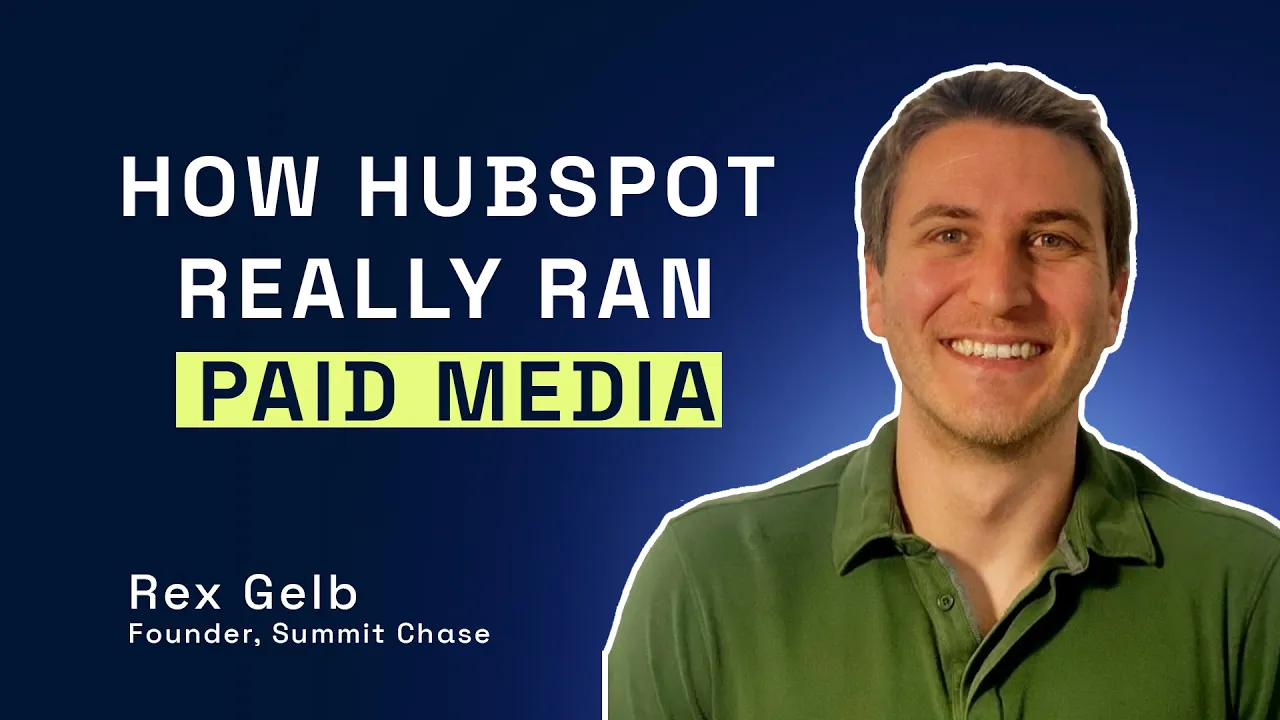
Rex Gelb ran paid media at HubSpot for about 11 years, through the wild years when every channel changed, attribution got harder, and budgets got bigger. These days, he advises startups and bigger brands (plus a lot in between), and he also runs Summit Chase after seeing enough agency work that didn’t impress him.
In this Office Hours session, Rex breaks down why “good performance” often doesn’t turn into pipeline, what to do when you’re starting small, and how to use AI features without letting the platforms drive the bus off a cliff.
And if you want to get deeper insight into what Rex and Pranav chatted about, check out the presentation they shared during their conversation.
Key takeaway
Paid media usually fails for operational reasons, not channel reasons. Optimize to meaningful signals (not clicks), respond to leads fast, start with enough budget to learn, and use platform AI - but audit it closely.
The gist
If you optimize for clicks, the platforms will find click-happy people.
Follow-up speed can wreck a program, even when the leads are good.
Start with enough budget to learn, then earn your way down the funnel as volume grows.
Lean into AI bidding and consolidation, then keep a close eye on what the platforms do.
Stop telling the platforms to win the wrong game
Rex started with a simple point that a lot of teams still miss: the ad platforms do what you tell them to do. If you’re optimizing to clicks, don’t act shocked when you get a bunch of clicks that don’t become pipeline.
His fix is also simple: pass back events you care about — leads, MQLs, SQLs, opportunities. Even if you can’t optimize to customers yet because you only get one a month, you can pick a proxy that’s closer to value than a click. Stuff like pricing page visits, time on site, CTA clicks, lead submits. Then as you scale and your weekly conversions go up, you move that optimization target further down the funnel.
This also came up with thought leadership ads on LinkedIn, where you can’t even pick “conversions” in the campaign setup.
The workaround Rex suggested: use view-through conversions and use LinkedIn’s revenue attribution report (RAR) connected to your CRM, so you can see things like pipeline by frequency (saw it once vs saw it eight times), and even at contact or company level.
Lead follow-up is the silent killer
Rex called this out because it’s sneaky. Paid media can be doing its job, and you’ll still lose.
If you generate the right lead and then wait too long, it goes stale fast. He said even 10 minutes can be too long, and 24 hours is usually a disaster. People forget who you are, talk to competitors, or, worse, move on.
Even “self-serve booking” can create the same problem if the demo ends up scheduled seven days later. The person was ready now, then you forced a pause. Rex said HubSpot was testing options like routing some people to a video demo instead of sales, and they were testing AI-style “avatar” experiences as he was leaving.
The takeaway is not “do fancy AI.” The takeaway is: don’t add delays after someone shows their interest.
How to start small without lying to yourself
Rex’s advice for early-stage budgets was pretty grounded.
He suggested around $10K to $15K per channel as a starting point to get enough volume to see if anything’s working. Early on, you don’t wait for revenue. You start with MQLs or booked meetings because you can get feedback quickly. Then you earn your way toward SQLs and opportunities as volume grows.
He also explained how to talk to finance and sales when they demand opportunity numbers too early. You show cost per MQL and use known conversion rates to estimate what cost per opportunity should look like if the funnel behaves like the rest of the business. That buys you budget to keep learning. If you spend $10K and get zero MQLs, you don’t get more budget. You go fix the basics.
On geo testing, Rex was clear: he doesn’t start there for small budgets because you usually won’t have enough volume to detect lift, especially in B2B.
Use AI features, then watch them like a hawk
Rex’s position on platform AI was practical, not hypey.
He’s saying the old days of constant micro-tweaks are fading. If you try to handcuff the system with tiny budgets and tiny audience splits, you’re fighting hundreds of real-time inputs with a human brain and a spreadsheet. Consolidation often works better now (one budget across a region instead of splitting into three small ones).
But he also didn’t say “trust the platforms blindly.” He said lean into AI and try it, then keep checks in place:
Watch the search terms
Read the auto-written copy
Check what landing pages the system is picking
Review breakdowns and reporting often
Treat it like an intern that’s smart but new.
What Rex says
“If you're still just optimizing to clicks in your system, don't be surprised if you just end up with a lot of click-happy people."
“If you're like waiting even 10 minutes, It's kind of too long.”
“My general position is to lean into AI and try it, but then just watch it.”
“The name of the game now is creative diversity.”
“I think incrementality really is going to play a bigger and bigger role.”
Why it matters
A lot of paid programs fail in boring ways.
They aren’t failing because the channel “doesn’t work.” They fail because the tracking is wrong, the optimization target is wrong, the follow-up is slow, or the team tries to control every lever while the platforms quietly got better at this than humans.
If you fix those basics, you can spend small and learn fast. Then when you do scale, you’re not guessing with six figures a month.
Practical next steps
Stop optimizing to clicks. Pick the closest event you can support with volume (lead, MQL, pricing-page visit, time-on-site) and feed it back to the platform.
If you run thought leadership ads on LinkedIn, set up conversion tracking anyway and review view-through results. If you can, connect the CRM and use the revenue attribution report.
Tighten speed-to-lead. Make it hard for a good lead to wait. If you can’t get a human fast, give them a good next step right away.
Start with $10K to $15K per channel and use MQLs or meetings to earn more budget. Move down-funnel as sample size grows.
Don’t start with geo tests at small budgets in B2B. You likely won’t detect lift.
Lean into AI bidding and broader structures, then audit what the platforms are doing weekly (search terms, auto-copy, landing pages, breakdowns).
Increase creative volume and variety. Different formats, different hooks, different looks. Let the system find what works where.
Episode Highlights
Transcript
Behind the expert
Rex Gelb ran paid media at HubSpot for about 11 years, through the wild years when every channel changed, attribution got harder, and budgets got bigger. These days, he advises startups and bigger brands (plus a lot in between), and he also runs Summit Chase after seeing enough agency work that didn’t impress him.
In this Office Hours session, Rex breaks down why “good performance” often doesn’t turn into pipeline, what to do when you’re starting small, and how to use AI features without letting the platforms drive the bus off a cliff.
And if you want to get deeper insight into what Rex and Pranav chatted about, check out the presentation they shared during their conversation.
Key takeaway
Paid media usually fails for operational reasons, not channel reasons. Optimize to meaningful signals (not clicks), respond to leads fast, start with enough budget to learn, and use platform AI - but audit it closely.
The gist
If you optimize for clicks, the platforms will find click-happy people.
Follow-up speed can wreck a program, even when the leads are good.
Start with enough budget to learn, then earn your way down the funnel as volume grows.
Lean into AI bidding and consolidation, then keep a close eye on what the platforms do.
Stop telling the platforms to win the wrong game
Rex started with a simple point that a lot of teams still miss: the ad platforms do what you tell them to do. If you’re optimizing to clicks, don’t act shocked when you get a bunch of clicks that don’t become pipeline.
His fix is also simple: pass back events you care about — leads, MQLs, SQLs, opportunities. Even if you can’t optimize to customers yet because you only get one a month, you can pick a proxy that’s closer to value than a click. Stuff like pricing page visits, time on site, CTA clicks, lead submits. Then as you scale and your weekly conversions go up, you move that optimization target further down the funnel.
This also came up with thought leadership ads on LinkedIn, where you can’t even pick “conversions” in the campaign setup.
The workaround Rex suggested: use view-through conversions and use LinkedIn’s revenue attribution report (RAR) connected to your CRM, so you can see things like pipeline by frequency (saw it once vs saw it eight times), and even at contact or company level.
Lead follow-up is the silent killer
Rex called this out because it’s sneaky. Paid media can be doing its job, and you’ll still lose.
If you generate the right lead and then wait too long, it goes stale fast. He said even 10 minutes can be too long, and 24 hours is usually a disaster. People forget who you are, talk to competitors, or, worse, move on.
Even “self-serve booking” can create the same problem if the demo ends up scheduled seven days later. The person was ready now, then you forced a pause. Rex said HubSpot was testing options like routing some people to a video demo instead of sales, and they were testing AI-style “avatar” experiences as he was leaving.
The takeaway is not “do fancy AI.” The takeaway is: don’t add delays after someone shows their interest.
How to start small without lying to yourself
Rex’s advice for early-stage budgets was pretty grounded.
He suggested around $10K to $15K per channel as a starting point to get enough volume to see if anything’s working. Early on, you don’t wait for revenue. You start with MQLs or booked meetings because you can get feedback quickly. Then you earn your way toward SQLs and opportunities as volume grows.
He also explained how to talk to finance and sales when they demand opportunity numbers too early. You show cost per MQL and use known conversion rates to estimate what cost per opportunity should look like if the funnel behaves like the rest of the business. That buys you budget to keep learning. If you spend $10K and get zero MQLs, you don’t get more budget. You go fix the basics.
On geo testing, Rex was clear: he doesn’t start there for small budgets because you usually won’t have enough volume to detect lift, especially in B2B.
Use AI features, then watch them like a hawk
Rex’s position on platform AI was practical, not hypey.
He’s saying the old days of constant micro-tweaks are fading. If you try to handcuff the system with tiny budgets and tiny audience splits, you’re fighting hundreds of real-time inputs with a human brain and a spreadsheet. Consolidation often works better now (one budget across a region instead of splitting into three small ones).
But he also didn’t say “trust the platforms blindly.” He said lean into AI and try it, then keep checks in place:
Watch the search terms
Read the auto-written copy
Check what landing pages the system is picking
Review breakdowns and reporting often
Treat it like an intern that’s smart but new.
What Rex says
“If you're still just optimizing to clicks in your system, don't be surprised if you just end up with a lot of click-happy people."
“If you're like waiting even 10 minutes, It's kind of too long.”
“My general position is to lean into AI and try it, but then just watch it.”
“The name of the game now is creative diversity.”
“I think incrementality really is going to play a bigger and bigger role.”
Why it matters
A lot of paid programs fail in boring ways.
They aren’t failing because the channel “doesn’t work.” They fail because the tracking is wrong, the optimization target is wrong, the follow-up is slow, or the team tries to control every lever while the platforms quietly got better at this than humans.
If you fix those basics, you can spend small and learn fast. Then when you do scale, you’re not guessing with six figures a month.
Practical next steps
Stop optimizing to clicks. Pick the closest event you can support with volume (lead, MQL, pricing-page visit, time-on-site) and feed it back to the platform.
If you run thought leadership ads on LinkedIn, set up conversion tracking anyway and review view-through results. If you can, connect the CRM and use the revenue attribution report.
Tighten speed-to-lead. Make it hard for a good lead to wait. If you can’t get a human fast, give them a good next step right away.
Start with $10K to $15K per channel and use MQLs or meetings to earn more budget. Move down-funnel as sample size grows.
Don’t start with geo tests at small budgets in B2B. You likely won’t detect lift.
Lean into AI bidding and broader structures, then audit what the platforms are doing weekly (search terms, auto-copy, landing pages, breakdowns).
Increase creative volume and variety. Different formats, different hooks, different looks. Let the system find what works where.
Episode Highlights
Transcript
Behind the expert
Rex Gelb ran paid media at HubSpot for about 11 years, through the wild years when every channel changed, attribution got harder, and budgets got bigger. These days, he advises startups and bigger brands (plus a lot in between), and he also runs Summit Chase after seeing enough agency work that didn’t impress him.
In this Office Hours session, Rex breaks down why “good performance” often doesn’t turn into pipeline, what to do when you’re starting small, and how to use AI features without letting the platforms drive the bus off a cliff.
And if you want to get deeper insight into what Rex and Pranav chatted about, check out the presentation they shared during their conversation.
Key takeaway
Paid media usually fails for operational reasons, not channel reasons. Optimize to meaningful signals (not clicks), respond to leads fast, start with enough budget to learn, and use platform AI - but audit it closely.
The gist
If you optimize for clicks, the platforms will find click-happy people.
Follow-up speed can wreck a program, even when the leads are good.
Start with enough budget to learn, then earn your way down the funnel as volume grows.
Lean into AI bidding and consolidation, then keep a close eye on what the platforms do.
Stop telling the platforms to win the wrong game
Rex started with a simple point that a lot of teams still miss: the ad platforms do what you tell them to do. If you’re optimizing to clicks, don’t act shocked when you get a bunch of clicks that don’t become pipeline.
His fix is also simple: pass back events you care about — leads, MQLs, SQLs, opportunities. Even if you can’t optimize to customers yet because you only get one a month, you can pick a proxy that’s closer to value than a click. Stuff like pricing page visits, time on site, CTA clicks, lead submits. Then as you scale and your weekly conversions go up, you move that optimization target further down the funnel.
This also came up with thought leadership ads on LinkedIn, where you can’t even pick “conversions” in the campaign setup.
The workaround Rex suggested: use view-through conversions and use LinkedIn’s revenue attribution report (RAR) connected to your CRM, so you can see things like pipeline by frequency (saw it once vs saw it eight times), and even at contact or company level.
Lead follow-up is the silent killer
Rex called this out because it’s sneaky. Paid media can be doing its job, and you’ll still lose.
If you generate the right lead and then wait too long, it goes stale fast. He said even 10 minutes can be too long, and 24 hours is usually a disaster. People forget who you are, talk to competitors, or, worse, move on.
Even “self-serve booking” can create the same problem if the demo ends up scheduled seven days later. The person was ready now, then you forced a pause. Rex said HubSpot was testing options like routing some people to a video demo instead of sales, and they were testing AI-style “avatar” experiences as he was leaving.
The takeaway is not “do fancy AI.” The takeaway is: don’t add delays after someone shows their interest.
How to start small without lying to yourself
Rex’s advice for early-stage budgets was pretty grounded.
He suggested around $10K to $15K per channel as a starting point to get enough volume to see if anything’s working. Early on, you don’t wait for revenue. You start with MQLs or booked meetings because you can get feedback quickly. Then you earn your way toward SQLs and opportunities as volume grows.
He also explained how to talk to finance and sales when they demand opportunity numbers too early. You show cost per MQL and use known conversion rates to estimate what cost per opportunity should look like if the funnel behaves like the rest of the business. That buys you budget to keep learning. If you spend $10K and get zero MQLs, you don’t get more budget. You go fix the basics.
On geo testing, Rex was clear: he doesn’t start there for small budgets because you usually won’t have enough volume to detect lift, especially in B2B.
Use AI features, then watch them like a hawk
Rex’s position on platform AI was practical, not hypey.
He’s saying the old days of constant micro-tweaks are fading. If you try to handcuff the system with tiny budgets and tiny audience splits, you’re fighting hundreds of real-time inputs with a human brain and a spreadsheet. Consolidation often works better now (one budget across a region instead of splitting into three small ones).
But he also didn’t say “trust the platforms blindly.” He said lean into AI and try it, then keep checks in place:
Watch the search terms
Read the auto-written copy
Check what landing pages the system is picking
Review breakdowns and reporting often
Treat it like an intern that’s smart but new.
What Rex says
“If you're still just optimizing to clicks in your system, don't be surprised if you just end up with a lot of click-happy people."
“If you're like waiting even 10 minutes, It's kind of too long.”
“My general position is to lean into AI and try it, but then just watch it.”
“The name of the game now is creative diversity.”
“I think incrementality really is going to play a bigger and bigger role.”
Why it matters
A lot of paid programs fail in boring ways.
They aren’t failing because the channel “doesn’t work.” They fail because the tracking is wrong, the optimization target is wrong, the follow-up is slow, or the team tries to control every lever while the platforms quietly got better at this than humans.
If you fix those basics, you can spend small and learn fast. Then when you do scale, you’re not guessing with six figures a month.
Practical next steps
Stop optimizing to clicks. Pick the closest event you can support with volume (lead, MQL, pricing-page visit, time-on-site) and feed it back to the platform.
If you run thought leadership ads on LinkedIn, set up conversion tracking anyway and review view-through results. If you can, connect the CRM and use the revenue attribution report.
Tighten speed-to-lead. Make it hard for a good lead to wait. If you can’t get a human fast, give them a good next step right away.
Start with $10K to $15K per channel and use MQLs or meetings to earn more budget. Move down-funnel as sample size grows.
Don’t start with geo tests at small budgets in B2B. You likely won’t detect lift.
Lean into AI bidding and broader structures, then audit what the platforms are doing weekly (search terms, auto-copy, landing pages, breakdowns).
Increase creative volume and variety. Different formats, different hooks, different looks. Let the system find what works where.

Our Guest
Rex Gelb - Founder, Summit Chase
Sign-up. Stay Sharp
Get the latest podcasts, new content drops, and fresh insights.