

The Brandformance Podcast

How neuroscience can make your marketing more memorable

Or listen where you get your podcasts

Or listen where you get your podcasts

Episode Highlights

Transcript

Behind the expert

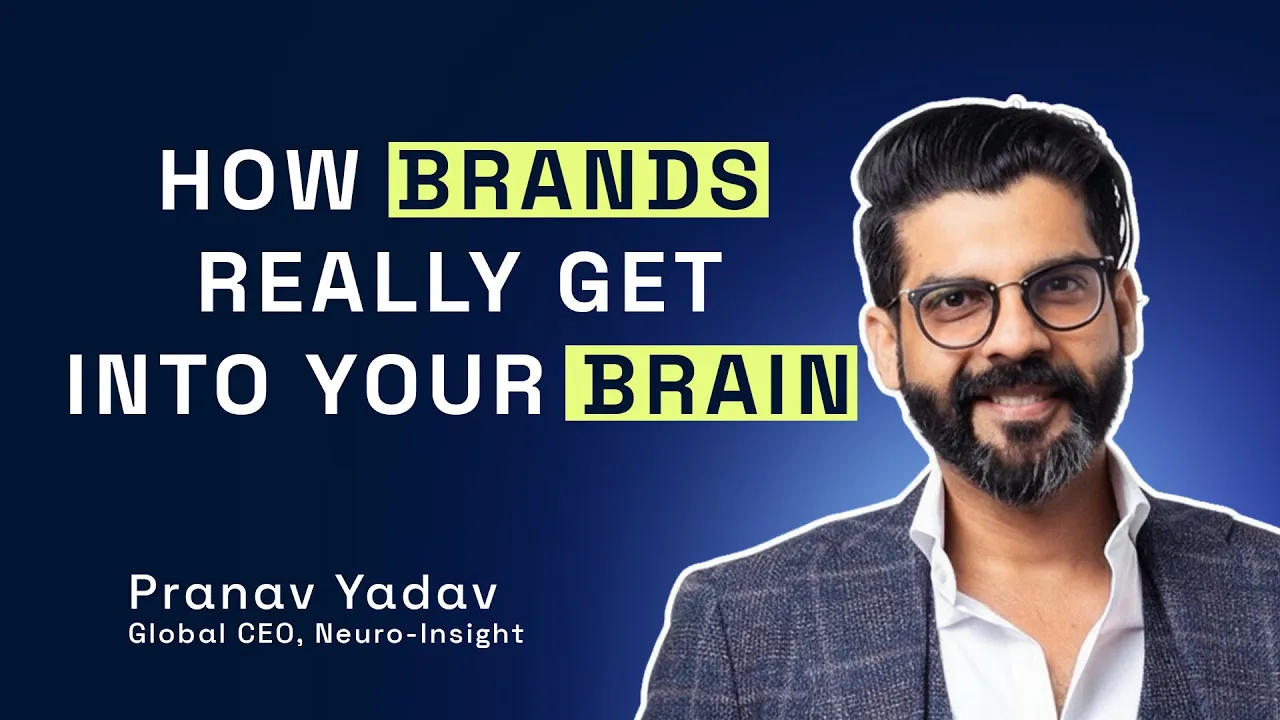
Pranav Yadav, CEO at Neuro-Insight, has spent years studying what people actually remember and feel when they watch ads — not what they say they remember, not what a dashboard says they watched. 

In this conversation, he breaks down brand as belief, calls most attention metrics a scam, and explains why the best creative can still fail if the brand doesn’t get encoded into memory. 

If you’re about to spend big on a launch or a big moment like the Super Bowl, this one will mess with your plans in a useful way.

Key takeaway

Views aren’t impact but memory is. If your creative doesn’t encode the brand into memory, you can win attention and still lose the business outcome.

The gist

  • Brand is the story people believe, and it shows up in the gap between “hard value” and what the market pays for.

  • Most “attention” metrics are just eyeballs, and eyeballs don’t tell you if anything actually worked.

  • Personal doesn’t have to mean one-to-one. It can mean one message that hits a lot of people the same way.

  • Great creative can still fail if the brand doesn’t get remembered inside the story.

Brand, personalization, and why views aren’t enough

Pranav’s definition of brand is simple in a way that hits hard. Companies have a “hard value” you can put on paper. Then the market prices them way above or way below that. In that gap is the story people believe about what’s possible. And from that, belief becomes the brand.

He also pushed back on hyper-personalization. His issue isn’t targeting by context when it makes sense. His issue is the idea that every person needs their own custom story. Humans don’t work like that. 

People want common stories they can share. He put it cleanly: “Personal does not mean individual for every individual.” Personal can be personal for a whole group.

Then he took a swing at attention metrics. The word “attention” in normal life means more than looking. “Pay attention” means look, listen, understand, and do something with it. Most marketing attention metrics measure one thin slice: eyeballs. Useful as a reach check, sure. Not useful as a stand-in for impact.

Memory is the job, and context changes everything

Neuro-Insight’s whole approach is built around one idea: most decision-making isn’t conscious. People can’t always explain why they like something, so post-ad surveys often turn into a “sounds smart” recap that doesn’t match what happens later.

So they measure brain response in the moment and look for things tied to memory, emotion, and relevance. And they don’t pretend a cold lab setup is the same as real life. They try to recreate a viewing flow, so the ad shows up in a more natural way.

This becomes critical for big moments like the Super Bowl. Pranav’s point: context changes everything. Super Bowl viewing is usually a group experience. Loud room, people talking, snacks, distractions, game energy. Subtle jokes get missed. Emotional beats need to work for a group, not just a solo viewer on a phone. Testing has to match that environment.

He also gave the nightmare scenario: an ad can create massive memory for the story and almost none for the brand. His Budweiser example is the warning label. The ad gets loved. The brand doesn’t get remembered. You get applause and no movement.

What Pranav says

  • “It is not about the signal that the eye is sending to the brain. It's about what the brain chooses to do with it.”

  • “The context in which you view content matters and changes how you will perceive that content.”

  • “I want an insight into human behavior because that is our currency.”

Why it matters

You can spend a lot, get a lot of views, and still build nothing that lasts.

If you only measure “did someone see it,” you’ll keep shipping work that looks good in reports. The brain part that drives later choices (memory) stays empty. That’s how you end up with campaigns people love and share that don’t change the business. You can also end up with a big, expensive ad that wins the day and loses the year.

Practical next steps

  • Treat “attention” as reach, not impact. Use it to adjust how many people you truly reached. Don’t treat it like it tells you what landed.

  • When you test creative, test memory and brand linkage. Ask: what will people remember later, and will they connect it to us?

  • Match the test to the context. If it’s a Super Bowl ad, don’t judge it on a quiet laptop test. Build a game-like viewing setup.

  • Make the brand show up during the story, not after it. Don’t save it for a last-second logo screen when the emotional moment is already over.

  • Stop writing RTBs like a checklist. Start with the human truth underneath, then earn the right to attach your brand to it.

  • Build three tracks: insight (why people act), culture (what’s happening around them), and tactics (media + creative). If you’re only strong in tactics, you’ll keep guessing.

Episode Highlights

Transcript

Behind the expert

Pranav Yadav, CEO at Neuro-Insight, has spent years studying what people actually remember and feel when they watch ads — not what they say they remember, not what a dashboard says they watched. 

In this conversation, he breaks down brand as belief, calls most attention metrics a scam, and explains why the best creative can still fail if the brand doesn’t get encoded into memory. 

If you’re about to spend big on a launch or a big moment like the Super Bowl, this one will mess with your plans in a useful way.

Key takeaway

Views aren’t impact but memory is. If your creative doesn’t encode the brand into memory, you can win attention and still lose the business outcome.

The gist

  • Brand is the story people believe, and it shows up in the gap between “hard value” and what the market pays for.

  • Most “attention” metrics are just eyeballs, and eyeballs don’t tell you if anything actually worked.

  • Personal doesn’t have to mean one-to-one. It can mean one message that hits a lot of people the same way.

  • Great creative can still fail if the brand doesn’t get remembered inside the story.

Brand, personalization, and why views aren’t enough

Pranav’s definition of brand is simple in a way that hits hard. Companies have a “hard value” you can put on paper. Then the market prices them way above or way below that. In that gap is the story people believe about what’s possible. And from that, belief becomes the brand.

He also pushed back on hyper-personalization. His issue isn’t targeting by context when it makes sense. His issue is the idea that every person needs their own custom story. Humans don’t work like that. 

People want common stories they can share. He put it cleanly: “Personal does not mean individual for every individual.” Personal can be personal for a whole group.

Then he took a swing at attention metrics. The word “attention” in normal life means more than looking. “Pay attention” means look, listen, understand, and do something with it. Most marketing attention metrics measure one thin slice: eyeballs. Useful as a reach check, sure. Not useful as a stand-in for impact.

Memory is the job, and context changes everything

Neuro-Insight’s whole approach is built around one idea: most decision-making isn’t conscious. People can’t always explain why they like something, so post-ad surveys often turn into a “sounds smart” recap that doesn’t match what happens later.

So they measure brain response in the moment and look for things tied to memory, emotion, and relevance. And they don’t pretend a cold lab setup is the same as real life. They try to recreate a viewing flow, so the ad shows up in a more natural way.

This becomes critical for big moments like the Super Bowl. Pranav’s point: context changes everything. Super Bowl viewing is usually a group experience. Loud room, people talking, snacks, distractions, game energy. Subtle jokes get missed. Emotional beats need to work for a group, not just a solo viewer on a phone. Testing has to match that environment.

He also gave the nightmare scenario: an ad can create massive memory for the story and almost none for the brand. His Budweiser example is the warning label. The ad gets loved. The brand doesn’t get remembered. You get applause and no movement.

What Pranav says

  • “It is not about the signal that the eye is sending to the brain. It's about what the brain chooses to do with it.”

  • “The context in which you view content matters and changes how you will perceive that content.”

  • “I want an insight into human behavior because that is our currency.”

Why it matters

You can spend a lot, get a lot of views, and still build nothing that lasts.

If you only measure “did someone see it,” you’ll keep shipping work that looks good in reports. The brain part that drives later choices (memory) stays empty. That’s how you end up with campaigns people love and share that don’t change the business. You can also end up with a big, expensive ad that wins the day and loses the year.

Practical next steps

  • Treat “attention” as reach, not impact. Use it to adjust how many people you truly reached. Don’t treat it like it tells you what landed.

  • When you test creative, test memory and brand linkage. Ask: what will people remember later, and will they connect it to us?

  • Match the test to the context. If it’s a Super Bowl ad, don’t judge it on a quiet laptop test. Build a game-like viewing setup.

  • Make the brand show up during the story, not after it. Don’t save it for a last-second logo screen when the emotional moment is already over.

  • Stop writing RTBs like a checklist. Start with the human truth underneath, then earn the right to attach your brand to it.

  • Build three tracks: insight (why people act), culture (what’s happening around them), and tactics (media + creative). If you’re only strong in tactics, you’ll keep guessing.

Episode Highlights

Transcript

Behind the expert

Pranav Yadav, CEO at Neuro-Insight, has spent years studying what people actually remember and feel when they watch ads — not what they say they remember, not what a dashboard says they watched. 

In this conversation, he breaks down brand as belief, calls most attention metrics a scam, and explains why the best creative can still fail if the brand doesn’t get encoded into memory. 

If you’re about to spend big on a launch or a big moment like the Super Bowl, this one will mess with your plans in a useful way.

Key takeaway

Views aren’t impact but memory is. If your creative doesn’t encode the brand into memory, you can win attention and still lose the business outcome.

The gist

  • Brand is the story people believe, and it shows up in the gap between “hard value” and what the market pays for.

  • Most “attention” metrics are just eyeballs, and eyeballs don’t tell you if anything actually worked.

  • Personal doesn’t have to mean one-to-one. It can mean one message that hits a lot of people the same way.

  • Great creative can still fail if the brand doesn’t get remembered inside the story.

Brand, personalization, and why views aren’t enough

Pranav’s definition of brand is simple in a way that hits hard. Companies have a “hard value” you can put on paper. Then the market prices them way above or way below that. In that gap is the story people believe about what’s possible. And from that, belief becomes the brand.

He also pushed back on hyper-personalization. His issue isn’t targeting by context when it makes sense. His issue is the idea that every person needs their own custom story. Humans don’t work like that. 

People want common stories they can share. He put it cleanly: “Personal does not mean individual for every individual.” Personal can be personal for a whole group.

Then he took a swing at attention metrics. The word “attention” in normal life means more than looking. “Pay attention” means look, listen, understand, and do something with it. Most marketing attention metrics measure one thin slice: eyeballs. Useful as a reach check, sure. Not useful as a stand-in for impact.

Memory is the job, and context changes everything

Neuro-Insight’s whole approach is built around one idea: most decision-making isn’t conscious. People can’t always explain why they like something, so post-ad surveys often turn into a “sounds smart” recap that doesn’t match what happens later.

So they measure brain response in the moment and look for things tied to memory, emotion, and relevance. And they don’t pretend a cold lab setup is the same as real life. They try to recreate a viewing flow, so the ad shows up in a more natural way.

This becomes critical for big moments like the Super Bowl. Pranav’s point: context changes everything. Super Bowl viewing is usually a group experience. Loud room, people talking, snacks, distractions, game energy. Subtle jokes get missed. Emotional beats need to work for a group, not just a solo viewer on a phone. Testing has to match that environment.

He also gave the nightmare scenario: an ad can create massive memory for the story and almost none for the brand. His Budweiser example is the warning label. The ad gets loved. The brand doesn’t get remembered. You get applause and no movement.

What Pranav says

  • “It is not about the signal that the eye is sending to the brain. It's about what the brain chooses to do with it.”

  • “The context in which you view content matters and changes how you will perceive that content.”

  • “I want an insight into human behavior because that is our currency.”

Why it matters

You can spend a lot, get a lot of views, and still build nothing that lasts.

If you only measure “did someone see it,” you’ll keep shipping work that looks good in reports. The brain part that drives later choices (memory) stays empty. That’s how you end up with campaigns people love and share that don’t change the business. You can also end up with a big, expensive ad that wins the day and loses the year.

Practical next steps

  • Treat “attention” as reach, not impact. Use it to adjust how many people you truly reached. Don’t treat it like it tells you what landed.

  • When you test creative, test memory and brand linkage. Ask: what will people remember later, and will they connect it to us?

  • Match the test to the context. If it’s a Super Bowl ad, don’t judge it on a quiet laptop test. Build a game-like viewing setup.

  • Make the brand show up during the story, not after it. Don’t save it for a last-second logo screen when the emotional moment is already over.

  • Stop writing RTBs like a checklist. Start with the human truth underneath, then earn the right to attach your brand to it.

  • Build three tracks: insight (why people act), culture (what’s happening around them), and tactics (media + creative). If you’re only strong in tactics, you’ll keep guessing.

Sign-up. Stay Sharp

Get the latest podcasts, new content drops, and fresh insights.

By submitting this form you agree to our privacy policy.

Discover how Paramark analyzed $2.2B+ in marketing spend

By providing your contact info, you agree to receive communications from Paramark. You can opt-out at any time. For details, refer to our Privacy Policy.

See Paramark in action

Demystify marketing measurement & growth

Marketing trends and tactics, plus the latest insights, experiments, and content drops from Paramark. Written by our CEO, delivered straight to your inbox. Sign up. Stay sharp.

By providing your contact info, you agree to receive communications from Paramark. You can opt-out at any time. For details, refer to our Privacy Policy

Demystify marketing measurement & growth

Marketing trends and tactics, plus the latest insights, experiments, and content drops from Paramark. Written by our CEO, delivered straight to your inbox. Sign up. Stay sharp.

By providing your contact info, you agree to receive communications from Paramark. You can opt-out at any time. For details, refer to our Privacy Policy

Demystify marketing measurement & growth

Marketing trends and tactics, plus the latest insights, experiments, and content drops from Paramark. Written by our CEO, delivered straight to your inbox. Sign up. Stay sharp.

By providing your contact info, you agree to receive communications from Paramark. You can opt-out at any time. For details, refer to our Privacy Policy