
Episode Highlights
Transcript
Behind the expert
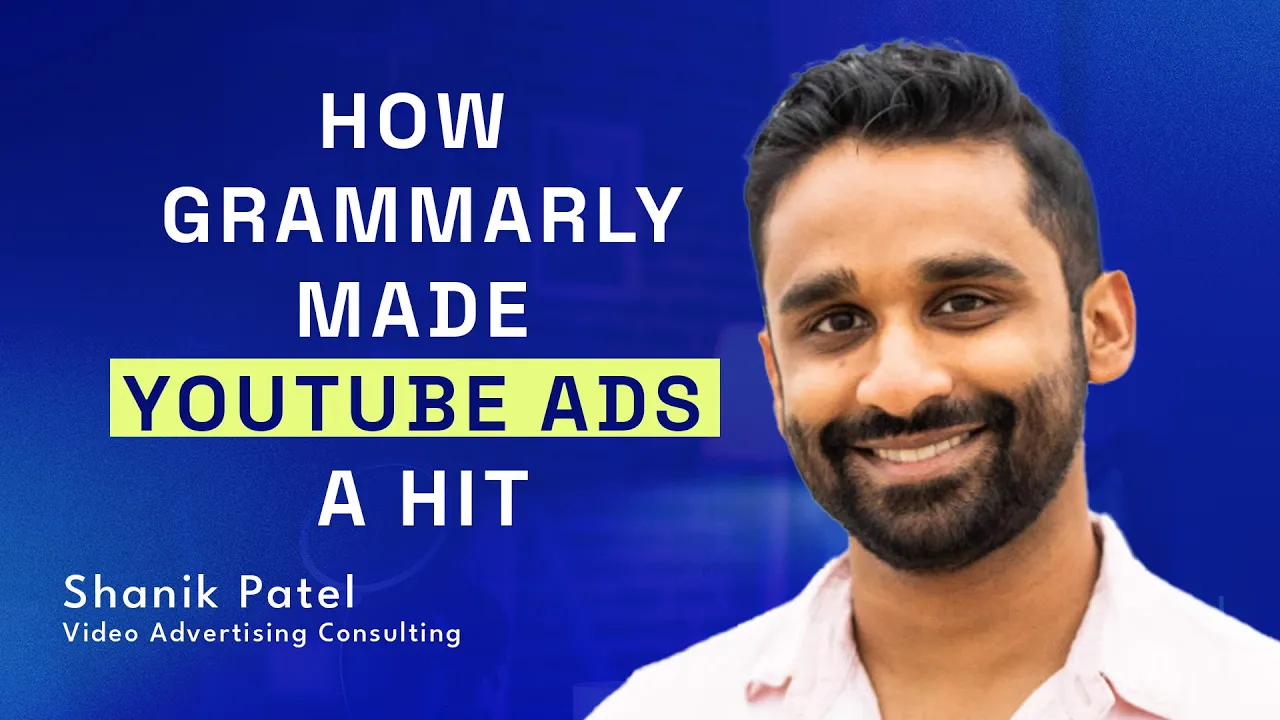
Shanik Patel led growth marketing at Grammarly after starting his career in finance, and, today, he specializes in YouTube and video performance.
He’s hands-on, pragmatic, and has scaled YouTube from first tests to a primary growth engine. We sat down with Shanik, and he covered when YouTube is the right channel, how to build scrappy modular creatives, the campaign structures that actually convert, and how to prove incremental lift.
This is perfect for anyone spinning up a YouTube strategy in the new year.
The gist
Check fit first: YouTube works when measurement, fast time-to-value, and budget are in place.
Creative is the lever: Start with modular user-generated content, then scale where you're seeing success.
Nail bottom-of-funnel: Use demand gen, intent-led audiences, and retargeting before moving up-funnel.
Prove impact: Expect view-through and latency, run lift tests, and triangulate with financial guardrails.
How to make YouTube work
Start with a foundation check
YouTube isn’t automatically right for every company or moment. You need reliable conversion tracking, the ability to run tests based on geographic location and turning ads on/off, and a fast path to value or a strong lead-capture flow.
For B2B, pair a low-friction action (free trial, freemium, or a compelling lead magnet) with a solid nurture stream. Plan meaningful learning with dedicated time and budget.
Win with creative, then scale with production
Treat creative as the make-or-break. Begin with use-generated content and a modular script system: multiple hooks for the first three seconds, interchangeable body modules, and at least two CTAs. That yields dozens of variants from one concept, and shooting vertical that you frame for horizontal doubles your set.
Launch direct-response cuts first. Once familiarity builds, shorter 15-second videos can stretch reach, while 30–60-second ones often convert best at the start.
Work the funnel in the right order
Prove bottom-of-funnel performance before you climb. Use demand gen campaigns to drive conversions, then layer in video-view or reach for consideration and awareness to extend longevity.
Entertain at the top, educate in the middle, sell clearly at the bottom.
Target with intent, not hope
Custom audiences are your edge. Combine search-intent keywords (Google and YouTube), competitor terms, relevant websites and apps, and in-market segments. Add lookalikes of purchasers or power users and retarget site visitors and ad engagers with sequential messaging. Exclude existing customers so spend hunts net-new demand.
Fix the post-click for lower-intent traffic
YouTube visitors arrive from entertainment mode. Mirror the ad’s promise on the page, add short demo video or GIF loops, simplify forms, and lean on nurture for those who convert after a few touches. If YouTube becomes a big slice of mix, bring those low-friction elements into your standard flows.
Measure real impact, not just the platform line
Most of YouTube's value is view-through and delayed. Expect brand search to rise with spend. Use geo lift and on/off pulses, and track CAC, LtV-to-CAC, and payback while scaling.
Triangulate platform data with controlled tests so you know when to push or pause.
What Shanik had to say
“I would say creative is 80% of the success of YouTube.”
“YouTube is not the place where you learn performance marketing.”
“Start scrappy with UGC (user-generated content). They’re fast and inexpensive to produce.”
“The first three seconds are critical to hook somebody.”
“For every one conversion that Google attributed to YouTube, we were actually driving two and a half times that in terms of total impact.”
Why this matters for your next YouTube flight
If you treat YouTube like search, you’ll miss most of the value. The channel can change trajectory, but only when you pair intent-led targeting and modular creative with low-friction pages and causal measurement. Start bottom-of-funnel with DR ads, build robust custom audiences, and set up a lift test you can run this quarter. Read beyond last click and seven-day windows so you scale on proof, not vibes.
Practical next steps:
Script one modular UGC concept into 40 variants; launch 30–60-second cuts first.
Build a custom audience mixing search intent, competitor terms, websites, apps, and in-market.
Stand up impactful tests; track brand search and payback as you scale.
If it works, reinvest in higher-production creative that mirrors the winning beats.
If you want to dive deeper into how to make YouTube ads work, here's the deck shared during our Office Hours session with Shanik.
Episode Highlights
Transcript
Behind the expert
Shanik Patel led growth marketing at Grammarly after starting his career in finance, and, today, he specializes in YouTube and video performance.
He’s hands-on, pragmatic, and has scaled YouTube from first tests to a primary growth engine. We sat down with Shanik, and he covered when YouTube is the right channel, how to build scrappy modular creatives, the campaign structures that actually convert, and how to prove incremental lift.
This is perfect for anyone spinning up a YouTube strategy in the new year.
The gist
Check fit first: YouTube works when measurement, fast time-to-value, and budget are in place.
Creative is the lever: Start with modular user-generated content, then scale where you're seeing success.
Nail bottom-of-funnel: Use demand gen, intent-led audiences, and retargeting before moving up-funnel.
Prove impact: Expect view-through and latency, run lift tests, and triangulate with financial guardrails.
How to make YouTube work
Start with a foundation check
YouTube isn’t automatically right for every company or moment. You need reliable conversion tracking, the ability to run tests based on geographic location and turning ads on/off, and a fast path to value or a strong lead-capture flow.
For B2B, pair a low-friction action (free trial, freemium, or a compelling lead magnet) with a solid nurture stream. Plan meaningful learning with dedicated time and budget.
Win with creative, then scale with production
Treat creative as the make-or-break. Begin with use-generated content and a modular script system: multiple hooks for the first three seconds, interchangeable body modules, and at least two CTAs. That yields dozens of variants from one concept, and shooting vertical that you frame for horizontal doubles your set.
Launch direct-response cuts first. Once familiarity builds, shorter 15-second videos can stretch reach, while 30–60-second ones often convert best at the start.
Work the funnel in the right order
Prove bottom-of-funnel performance before you climb. Use demand gen campaigns to drive conversions, then layer in video-view or reach for consideration and awareness to extend longevity.
Entertain at the top, educate in the middle, sell clearly at the bottom.
Target with intent, not hope
Custom audiences are your edge. Combine search-intent keywords (Google and YouTube), competitor terms, relevant websites and apps, and in-market segments. Add lookalikes of purchasers or power users and retarget site visitors and ad engagers with sequential messaging. Exclude existing customers so spend hunts net-new demand.
Fix the post-click for lower-intent traffic
YouTube visitors arrive from entertainment mode. Mirror the ad’s promise on the page, add short demo video or GIF loops, simplify forms, and lean on nurture for those who convert after a few touches. If YouTube becomes a big slice of mix, bring those low-friction elements into your standard flows.
Measure real impact, not just the platform line
Most of YouTube's value is view-through and delayed. Expect brand search to rise with spend. Use geo lift and on/off pulses, and track CAC, LtV-to-CAC, and payback while scaling.
Triangulate platform data with controlled tests so you know when to push or pause.
What Shanik had to say
“I would say creative is 80% of the success of YouTube.”
“YouTube is not the place where you learn performance marketing.”
“Start scrappy with UGC (user-generated content). They’re fast and inexpensive to produce.”
“The first three seconds are critical to hook somebody.”
“For every one conversion that Google attributed to YouTube, we were actually driving two and a half times that in terms of total impact.”
Why this matters for your next YouTube flight
If you treat YouTube like search, you’ll miss most of the value. The channel can change trajectory, but only when you pair intent-led targeting and modular creative with low-friction pages and causal measurement. Start bottom-of-funnel with DR ads, build robust custom audiences, and set up a lift test you can run this quarter. Read beyond last click and seven-day windows so you scale on proof, not vibes.
Practical next steps:
Script one modular UGC concept into 40 variants; launch 30–60-second cuts first.
Build a custom audience mixing search intent, competitor terms, websites, apps, and in-market.
Stand up impactful tests; track brand search and payback as you scale.
If it works, reinvest in higher-production creative that mirrors the winning beats.
If you want to dive deeper into how to make YouTube ads work, here's the deck shared during our Office Hours session with Shanik.
Episode Highlights
Transcript
Behind the expert
Shanik Patel led growth marketing at Grammarly after starting his career in finance, and, today, he specializes in YouTube and video performance.
He’s hands-on, pragmatic, and has scaled YouTube from first tests to a primary growth engine. We sat down with Shanik, and he covered when YouTube is the right channel, how to build scrappy modular creatives, the campaign structures that actually convert, and how to prove incremental lift.
This is perfect for anyone spinning up a YouTube strategy in the new year.
The gist
Check fit first: YouTube works when measurement, fast time-to-value, and budget are in place.
Creative is the lever: Start with modular user-generated content, then scale where you're seeing success.
Nail bottom-of-funnel: Use demand gen, intent-led audiences, and retargeting before moving up-funnel.
Prove impact: Expect view-through and latency, run lift tests, and triangulate with financial guardrails.
How to make YouTube work
Start with a foundation check
YouTube isn’t automatically right for every company or moment. You need reliable conversion tracking, the ability to run tests based on geographic location and turning ads on/off, and a fast path to value or a strong lead-capture flow.
For B2B, pair a low-friction action (free trial, freemium, or a compelling lead magnet) with a solid nurture stream. Plan meaningful learning with dedicated time and budget.
Win with creative, then scale with production
Treat creative as the make-or-break. Begin with use-generated content and a modular script system: multiple hooks for the first three seconds, interchangeable body modules, and at least two CTAs. That yields dozens of variants from one concept, and shooting vertical that you frame for horizontal doubles your set.
Launch direct-response cuts first. Once familiarity builds, shorter 15-second videos can stretch reach, while 30–60-second ones often convert best at the start.
Work the funnel in the right order
Prove bottom-of-funnel performance before you climb. Use demand gen campaigns to drive conversions, then layer in video-view or reach for consideration and awareness to extend longevity.
Entertain at the top, educate in the middle, sell clearly at the bottom.
Target with intent, not hope
Custom audiences are your edge. Combine search-intent keywords (Google and YouTube), competitor terms, relevant websites and apps, and in-market segments. Add lookalikes of purchasers or power users and retarget site visitors and ad engagers with sequential messaging. Exclude existing customers so spend hunts net-new demand.
Fix the post-click for lower-intent traffic
YouTube visitors arrive from entertainment mode. Mirror the ad’s promise on the page, add short demo video or GIF loops, simplify forms, and lean on nurture for those who convert after a few touches. If YouTube becomes a big slice of mix, bring those low-friction elements into your standard flows.
Measure real impact, not just the platform line
Most of YouTube's value is view-through and delayed. Expect brand search to rise with spend. Use geo lift and on/off pulses, and track CAC, LtV-to-CAC, and payback while scaling.
Triangulate platform data with controlled tests so you know when to push or pause.
What Shanik had to say
“I would say creative is 80% of the success of YouTube.”
“YouTube is not the place where you learn performance marketing.”
“Start scrappy with UGC (user-generated content). They’re fast and inexpensive to produce.”
“The first three seconds are critical to hook somebody.”
“For every one conversion that Google attributed to YouTube, we were actually driving two and a half times that in terms of total impact.”
Why this matters for your next YouTube flight
If you treat YouTube like search, you’ll miss most of the value. The channel can change trajectory, but only when you pair intent-led targeting and modular creative with low-friction pages and causal measurement. Start bottom-of-funnel with DR ads, build robust custom audiences, and set up a lift test you can run this quarter. Read beyond last click and seven-day windows so you scale on proof, not vibes.
Practical next steps:
Script one modular UGC concept into 40 variants; launch 30–60-second cuts first.
Build a custom audience mixing search intent, competitor terms, websites, apps, and in-market.
Stand up impactful tests; track brand search and payback as you scale.
If it works, reinvest in higher-production creative that mirrors the winning beats.
If you want to dive deeper into how to make YouTube ads work, here's the deck shared during our Office Hours session with Shanik.
Sign-up. Stay Sharp
Get the latest podcasts, new content drops, and fresh insights.