Case Studies
How Steno measured the 'unmeasurable' in the legal realm
How Steno confidently doubled their OOH spend after measuring a first-of-its-kind event campaign with incrementality

Sam Faillace
VP of Marketing
How Steno confidently doubled their OOH spend after measuring a first-of-its-kind event campaign with incrementality
Think of Steno as a stress test for modern measurement.
Steno is not your typical digital-first brand — and that’s why their story matters. They sell court reporting and litigation support services in a historically relationship-driven, offline industry where demand is sudden and sometimes last-minute. Their digital signals typically reflect conversion, not the marketing that actually drove awareness and demand.
If a company with a predominantly offline-led buyer journey can confidently measure marketing impact, unlock new acquisition channels and scale out-of-home spend using incrementality, any brand can.
In 2023, Steno’s early, one-person marketing effort was limited to Google Ads, last-touch attribution and an incremental business impact of less than one percent.
Just over one year later, a partnership with Paramark helped power an out-of-home event takeover that netted three times the number of jobs they hypothesized and an outcome that was previously unmeasurable with their old approach.
“We're trying new channels, we're adding new sales reps, we're expanding into new markets. If I'm not testing, how do I know that our modeling is still accurate?”
– Dan Malgran, Vice President of Marketing
Paramark empowered Steno to go from tracking narrow, last-mile clicks to illuminating their complete, dynamic customer journey — ultimately leading to a decision to double their out-of-home spend in 2026 and boldly execute offline campaigns like airport takeovers, billboards and panel discussions.
Partnering with the incrementality platform and Paramark’s growth advisors gave Steno’s marketing team “a sense of freedom,” Dan Malgran, vice president of marketing, said.
“If we hadn’t implemented Paramark, we wouldn’t be as brave.”
Who is Steno?
Steno is a modern legal court reporting and legal technology company that provides court reporting, deposition and litigation support services to law firms and legal teams.
Together we built a way to measure Steno’s sales motion, which is historically relationship-driven and offline and often relies on trusted partnerships, referrals and long-standing client relationships rather than digital demand generation.
Today, we’ve worked with Steno to improve visibility into which offline channels drive growth, such as out-of-home and event marketing, while also proving the business impact of marketing in a sales process with limited digital signals.
The problem: Measuring a non-digital buyer journey
“Because our sales cycle is not particularly digital — our reps are in the field 60% of the time — a lot of parts of our sales cycle don't get tracked by more traditional attribution channels or software,” Malgran said.
By relying on digital-first attribution, Malgran and his team were not measuring existing channels that drove new business: out-of-home ads, events, print mail and in-person meetings.
But the more problematic issue was that other things weren’t being done at all. Steno’s executive team was ready to tap into thought leadership content, keynotes, panels, PR efforts and out-of-home with a bigger splash.
Brand awareness was a top priority, because a typical Steno customer becomes aware of the product weeks before they book them for a deposition. They might first see the brand at an event or attend a webinar, and then later read an article or guide, both long before they click on an ad.
“We’re not in an industry where people book demos from paid social,” Malgran explained. But the minute that someone does need a court reporting service like Steno, the buying process can happen in less than a day.
Because demand emerges suddenly and conversions happen fast, Malgran prioritized incrementality as the foundation for scaling pre-purchase influence channels that wouldn’t show up in standard attribution.
The search for a measurement partner that wouldn’t set up a ‘marketing vs. sales’ credit battle
Early on, it was clear that any direct attribution tool would set up a battle for credit between sales and marketing.
“I don't like working in an environment where there's ‘sales-sourced’ and ‘marketing-sourced’ and we're fighting over who owns what,” Malgran said. Instead, he wondered, “What kind of measurement could make us feel more like a team, to allow us to say ‘Here's how what we’re doing is incremental to what sales is doing’?”
Malgran pitched the idea of an incrementality platform to his CEO and started the internal conversations, including with finance.
For any marketing leader implementing incrementality, getting your internal stakeholders on board — like finance, RevOps or your own team — is a necessary first step, Malgran said. And give plenty of time for Q&A.
“Don't necessarily just push to get it done,” he cautioned. “It’s outside the comfort zone of many of these people. They will have a lot of questions. They won’t voice all of them in the first meeting, but they are under the surface. You need to find them and make them feel comfortable before implementation.”
“Once you make your stakeholders feel comfortable, the implementation and acceptance of incrementality is going to be a lot easier.”
– Dan Malgran, Vice President of Marketing
Why Steno turned to Paramark
Steno first came to Paramark with an aim to expand their paid social efforts, especially on LinkedIn. They already knew customers wouldn’t be filling out a demo form in direct response to platform ads.
Previously, they spent a sizable portion of their marketing budget on demo request ads, but saw little return.
“My theory was that with Marketing Mixed Modeling (MMM), we would be able to see that [LinkedIn content] has a much broader downstream impact,” Malgran said.
The goal was to shift to thought leadership content that would meaningfully manifest in their paid search and organic inbound.
When Pranav Piyush, Paramark’s CEO, first gave Steno’s executive team a demo, it was the dual approach of MMM and testing that sold them, for the combined power of historical data and constant experimentation.
“We're trying new channels, we're adding new sales reps, we're expanding into new markets. If I'm not testing, how do I know that it's still accurate?” Malgran said.

The Paramark team’s closeness to the measurement model and their bespoke test design was also a win.
“They’re very confident in what they’re doing, and that’s made us more confident, too,” he added.
Once on board, we laid out this three-step plan for Steno:
Expand LinkedIn content to measure downstream impact on the number of jobs booked
Trial bigger out-of-home campaigns and track incremental jobs booked as a result
Conceptualize tests for platforms like Reddit where Steno did not yet have a presence
“The sales results of our first event marketing test — more than three times what we expected — was a real tipping point for us. In 2026, we built in a lot more out-of-home tests. We've been able to model our tests in a way we wouldn't have been able to do with any other tools, with a lot more confidence from finance.”
–Dan Malgran, Vice President of Marketing
The unlock: How Steno tested a New York City event takeover that resulted in 3X the predicted jobs
Until 2025, Steno had only experimented with small out-of-home media, like print ads and direct mail. They dreamed of taking over billboards in New York City and making a bigger in-real-life splash.
“We kept saying, ‘That would be really cool,’ [but] there wasn’t a direct way of tracking it.”
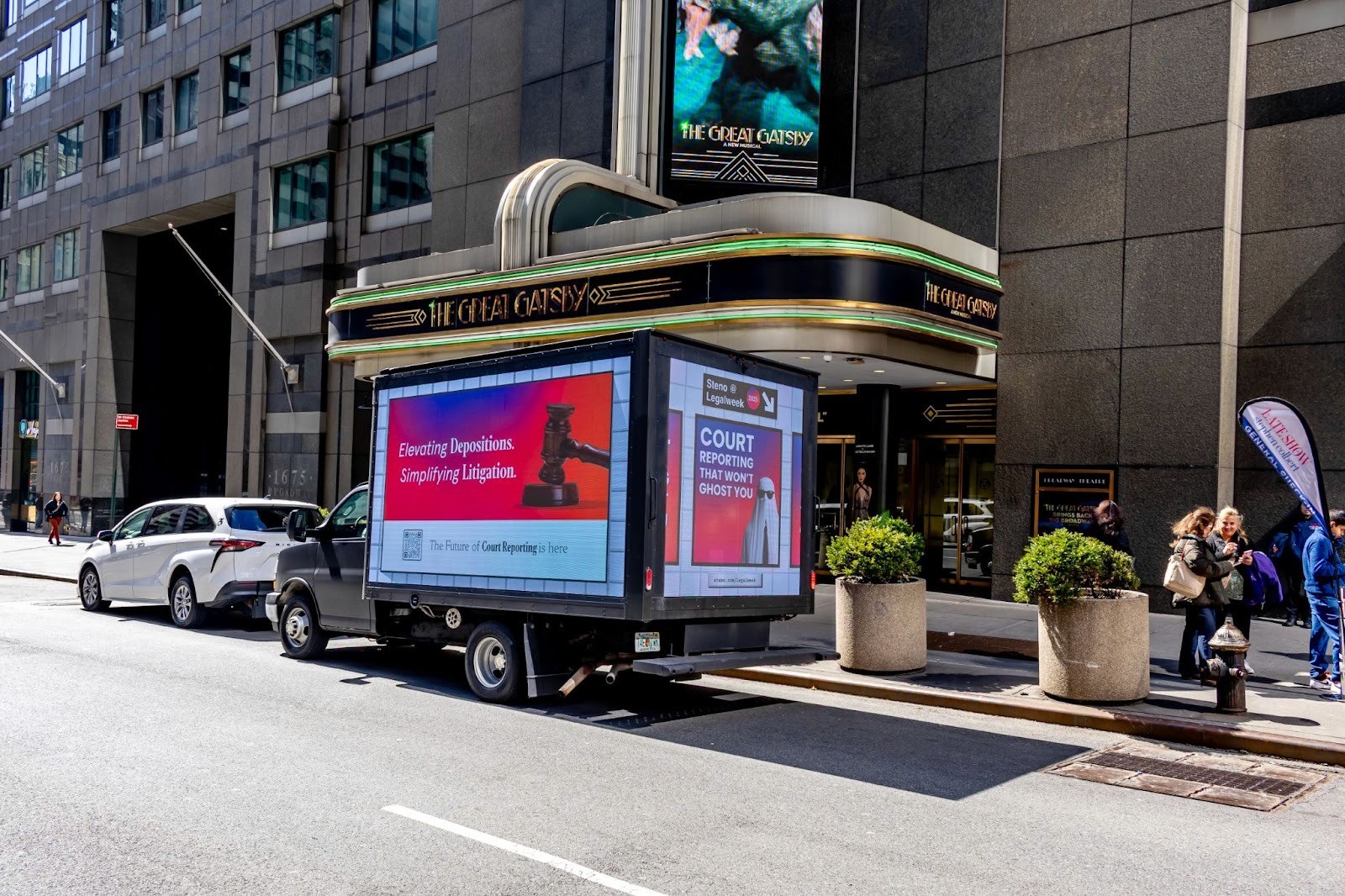
With Paramark by their side, they took a leap and experimented with an out-of-home takeover at Legal Week in March 2025.
They did it all — video ads in elevators, digital billboards and a video truck circulating the event.

Their hypothesis: Steno would book 80 incremental jobs as a result.
The result: They booked more than 300 incremental jobs — jobs they would not have booked without the event campaign — more than triple their goal.
“That was a real tipping point for us,” Malgran said.
“In 2026, we built in a lot more out-of-home tests, and much larger out-of-home tests,” he added. “We've been able to model our tests in a way we wouldn't have been able to do with any other tools, with a lot more confidence from finance.”
After the successful event test, Steno’s marketing team plans to double their spend on out-of-home this year.
How Paramark amplified Steno’s success with ‘brave’ marketing
Paramark helped unlock a sense of boldness within Steno’s marketing team by giving them the tools to launch and prove the impact of unprecedented channels, Malgran said.
“Our success comes from being brave in an older, professional industry.”
Abdul Umer, Steno’s director of integrated marketing, added: “Paramark has provided a sense of freedom.”
“I can do what I like with my platform optimizations, within experiment design parameters. Not only do I understand the impact from the results of the experiment, but I get my own platform and channel learnings at the same time.”
Because incrementality expertise is still not widespread in the marketing industry, Malgran and his team also rely on Paramark’s hands-on support and built-in growth advisory team.
“You need to have a partner that is more than just a tech tool.”
As Steno continues to scale, what’s next?
Steno is now testing Reddit ads with Paramark. Their early click-through rate was double the experiment hypothesis, a promising sign of progress on a new platform.
But doubling their out-of-home spend in 2026, Steno plans to take bigger swings on physical media.
“If we hadn't implemented Paramark, we would still be stuck in direct attribution,” Malgran said. “Incrementality is now our number one [marketing] pillar.”

While you're here




Find your edge
Book a demo now and you'll get a live, expert-run walk through of how Paramark can help you with incrementality measurement and experimentation.